
By Kwame Aidoo, Ghana
While the idea of ‘top artists’ shelved on lists remains contested, the 2025 ArtReview Power 100 list could be weighed as rather fair, having projected appreciative attention away from the Western canon. Ibrahim Mahama, blaxTARLINES, and other artists and collectives from Africa and the diaspora on the ArtReview’s Power 100 list 2025 have been making their own strides and tables, rather than waiting for any reserved table to share spare seats. This they’ve accomplished by boldly contributing to shaping spaces of intellectual, curatorial, and institutional leadership, both locally and internationally.
BEYOND RUINS, THE RISE: IBRAHIM MAHAMA’S WIN
Ghanaian artist Ibrahim Mahama’s historic rise as the first African artist to achieve this milestone, did not happen overnight. Mahama’s practice has drawn out beyond art objects to building cultural infrastructure with art sales profits. Red Clay Studio, Savannah Centre for Contemporary Art (SCCA) and Nkrumah Volini in Tamale, have been “living” testaments for a number of years now.
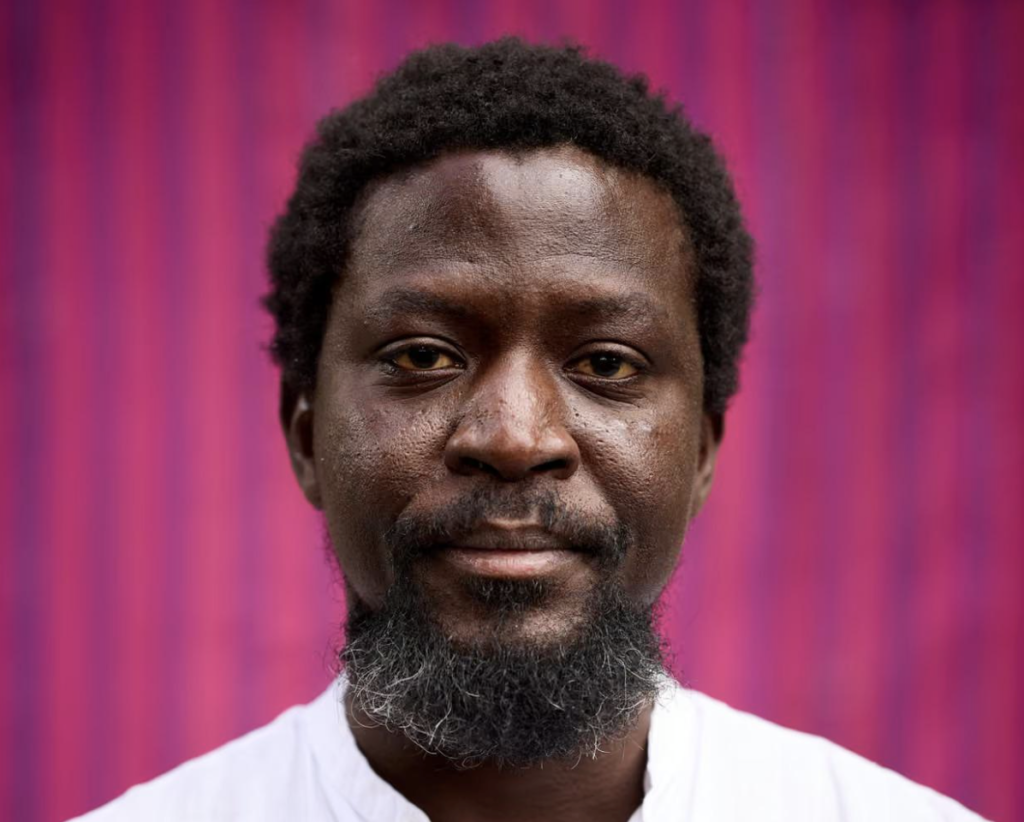
Ibrahim Mahama’s work includes large-scale installations and art infrastructure. Photograph: David Levene/The Guardian
Where labour often exceeds commercial metrics, Mahama’s art documents the working hands, the entangling histories and the burdened logistical materials. While zooming into visual codes of naming on cocoa sacks or fore arms or X-ray images of spinal deformation, the artist stands at the far end of capitalism’s exploits and asks us to look at extraction, labour and migration differently. From stacks of shoemaker boxes to colonial train guts mounted on pillars of stacked market porter pans, the artist captures the void that exploitation sheds in both poetic and literal terms. Through collaborations, space creation and collecting, potential community analeptics or spaces for intervention happen. Ruins coloured with human strain are amplified from the minimalist to the monumental, the contemporary to the historic.
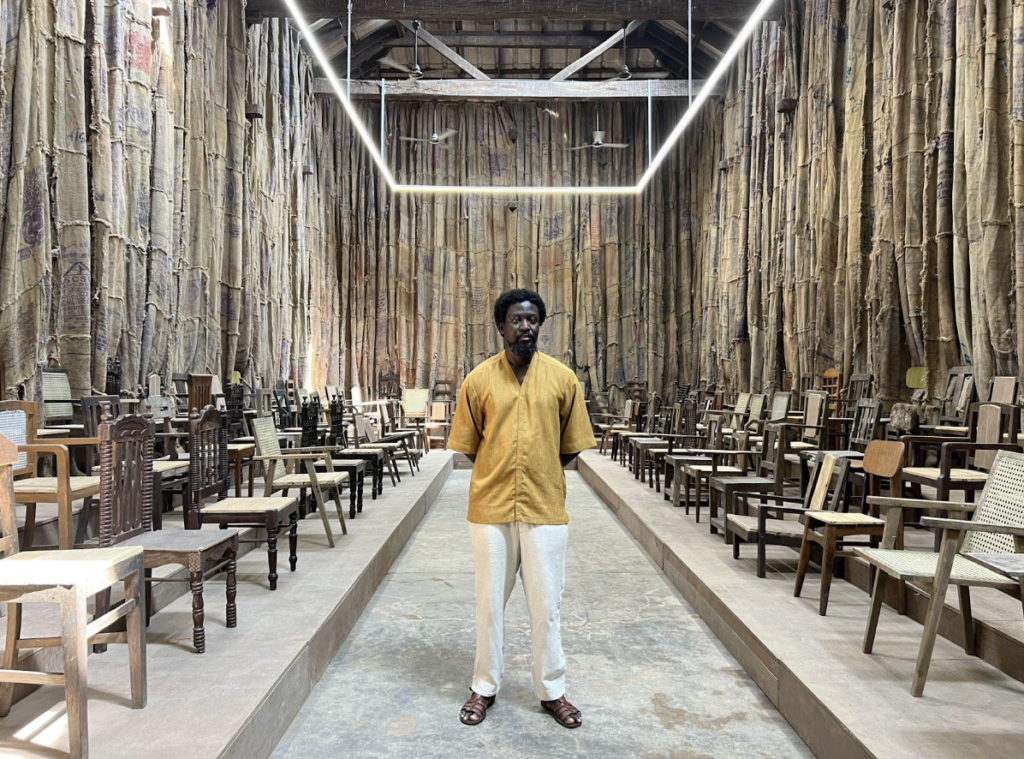
Ibrahim Mahama inside with his installation at Anand Warehouse, 2025 Photograph: Courtesy of the Kochi Biennale Foundation
Students, workers including shoe repairers, weavers, women porters, farmers, railway workers, traders, colonial-era labour forces and communities whose lives underpin national economies yet remain largely invisible, have their voices lifted. In Parliament of Ghosts, Mahama switches the formal institution meaning of “parliament” to a metaphoric one, gathering histories and inviting collective presence and pondering. The question “whose labour makes economies possible?” comes to the surface. A major early work with stitched jute sacks, curated by Okwui Enwezor, Out of Bounds (56th Venice Biennale, 2015), covered the Arsenale walls at the 56th Venice Biennale. Non-Orientable Nkansa (2016) 1901-2030, is an assemblage of exchanged shoemaker boxes, construction boards, old train parts and mix media. Purple Hibiscus (2023–24) wrapped the 2,000 m² brutalist architecture at London’s Barbican Centre.
blaxTARLINES AS “OPEN SOURCE” COMMUNITY
The artist collective – organisational network and incubator for art in Ghana, blaxTARLINES, which has consistently been an important bedrock for Mahama’s philosophies and practice, came up 69th on the ArtReview list. ‘blaxTARLINES is a concept; a paradigm; an “open source” coalition; and critical intellectual community operating on a fractal model of collectivism,’ curator Kwasi Ohene-Ayeh explains. The distinguished art school of Kwame Nkrumah University of Science and Technology, the alma mater of both Ibrahim Mahama and Kwasi Ohene-Ayeh is where the cross-generational meeting point of lecturers, artists, and curators blaxTARLINES is based.
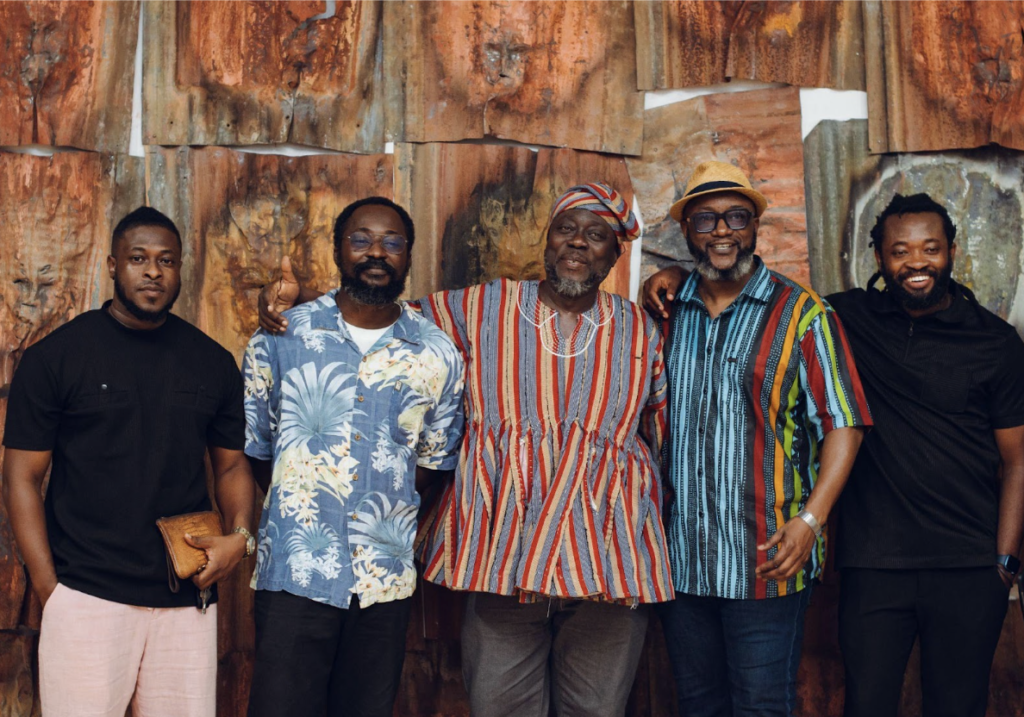
Photo from the opening reception of blaxTARLINES co-founder, Edwin Bodjawah’s solo exhibition Zado Keli: Eclipse of a Continent? (From left: Kelvin Haizel, Kwasi Ohene-Ayeh (curator of the exhibition), Edwin Bodjawah, George Buma Ampratwum, Hassan Issah) Photograph: Daniel Mensah Boafo
SHAPES OF CULTURE: OTHER BLACK ARTISTS REPRESENTING
The capacity to shape cultural conversations and institutional priorities, sees top African and diaspora artists scaling beyond this list. Out of the Artreview top 10, at number 4 is the artistic director of the inaugural Art Basel Qatar 2026 Wael Shawky. New York based Amy Sherald, who documents contemporary African American experiences is at number 6, while the influential painter Kerry James Marshall follows next in line. Saidiya Hartman, an academic and writer, follows at number 8, and at number 12 is the visual artist Mark Bradford. Following closely is Julie Mehretu, known for large scale abstracted paintings.
At number 13 is Yinka Shonibare, the pioneering leader with interest in supporting emerging artists, and at 16 is Theaster Gates who was number 32 in 2024. At number 20 is the philosopher Olúfẹ́mi O. Táíwò, renowned cultural producer Bonaventure Soh Bejeng Ndikung is at 26, filmmaker John Akomfrah is at 27, while photographer Sammy Baloji is at 31. Curator Naomi Beckwith, thinker Fred Moten, curators Azu Nwagbogu and Marie Hélène Pereira, are placed at numbers 35, 37, 45 and 55 respectively.
Martinique is a Caribbean island in the Lesser Antilles, populated predominantly by people of African descent. From 1635, there was French colonization until 1946, when Martinique became a French overseas department. Last October, Cameron Rowland replaced the French flag on Palais de Tokyo’s façade with the Martinique flag as a commentary on colonial power structures. Shortly after the exhibition opened, Palais de Tokyo removed the installation, stating it could be considered illegal. On the Power 100 list, Cameron Rowland settles at the 64th spot. At number 68 is Dalton Paula and blaxTARLINES is at 69. Curator Aaron Cezar is at 70, the artist collective Cercle D’Art Des Travailleurs de Plantation Congolaise, makes number 82, while last but not the least, curator Thiago de Paula Souza is 97th. The ArtReview Power 100 list was inaugurated in 2002, and according to Artsy’s demographic analysis, the first list had a very small number of figures who identified as Black- curators Thelma Golden, Okwui Enwezor and Lowery Sims.

In place of the French national flag, the Martinican flag flies on Palais de Tokyo’s facade. Artist: Cameron Rowland. Photograph: Instagram screenshots from Maxwell Graham Gallery
Beyond traditional Western yardsticks, ArtReview’s current Power 100 was compiled by a panel of around 30 anonymous individuals globally. In terms of advocacy, collaboration, and cultural policy engagement across Africa, Ibrahim Mahama’s win from the heart of Ghana’s third-largest and rapidly growing city, Tamale, is a win for all of Africa and the diaspora, in validation of artist-led models. In totality, the work of blaxTARLINES and influential African and diaspora artists, some of whom you cannot find on this list, propel the framing of contemporary African art as a critical driver of sociopolitical and economic development, highlighting how fostering stronger local cultural ecosystems on the continent assists in guiding global inclusivity.
Editor’s Note

Kwame Aidoo is a Ghanaian writer, poet, and cultural worker whose work explores heritage, memory, identity, and pan-African solidarity. He collaborates across disciplines to advocate for cultural infrastructure and creative economy transformation in Africa and the diaspora.
Kwame Aidoo reflects on the growing global presence of African and diaspora artists featured in the 2025 ArtReview Power 100 list—particularly highlighting Ibrahim Mahama’s historic ascent and the critical role of artist-led infrastructures like blaxTARLINES.
At a time when recognition is shifting beyond the West’s traditional canon, this article explores how African creators are not merely joining tables—they are building their own. From Tamale to global biennales, these movements signal the importance of sustained investment in local ecosystems. Their success reinforces CfCA’s call for #1PercentForCulture as a pathway to strengthening cultural infrastructures that enable artists to shape institutions, not just participate in them.
