By Patrick Ssentongo, KAMPALA-UGANDA
When Uganda embarked on the process of amending its Copyright and Neighbouring Rights law, artists and rights holders identified the Private Copy Levy (PCL) as one of the most critical reforms needed to align the country’s copyright framework with contemporary digital realities.
In copyright-law systems globally, a private copying levy (also called a private-copy compensation scheme) is a mechanism by which devices or media capable of copying/storing content — such as smartphones, computers, memory cards, USB drives, CDs/DVDs — are taxed (or charged a small levy) at import or sale. The levy is intended not for the government’s treasury, but as compensation to creators (musicians, artists, authors ) for the fact that their works may be copied privately by users rather than purchased legitimately.
In principle, this gives rights-holders a way to be remunerated even when their works are privately copied rather than formally purchased or licensed — a useful approach in environments where monitoring or enforcing individual copying is near-impossible.
Yet, despite strong backing from the creative sector, the PCL was excluded from the clauses presented to the Parliament of Uganda by the Government through Hon. Nobert Mao, the Minister of Justice and Constitutional Affairs in the Copyright and Neighbouring Rights (Amendment) Bill, 2025—triggering widespread concern among artists, authors and collecting societies.
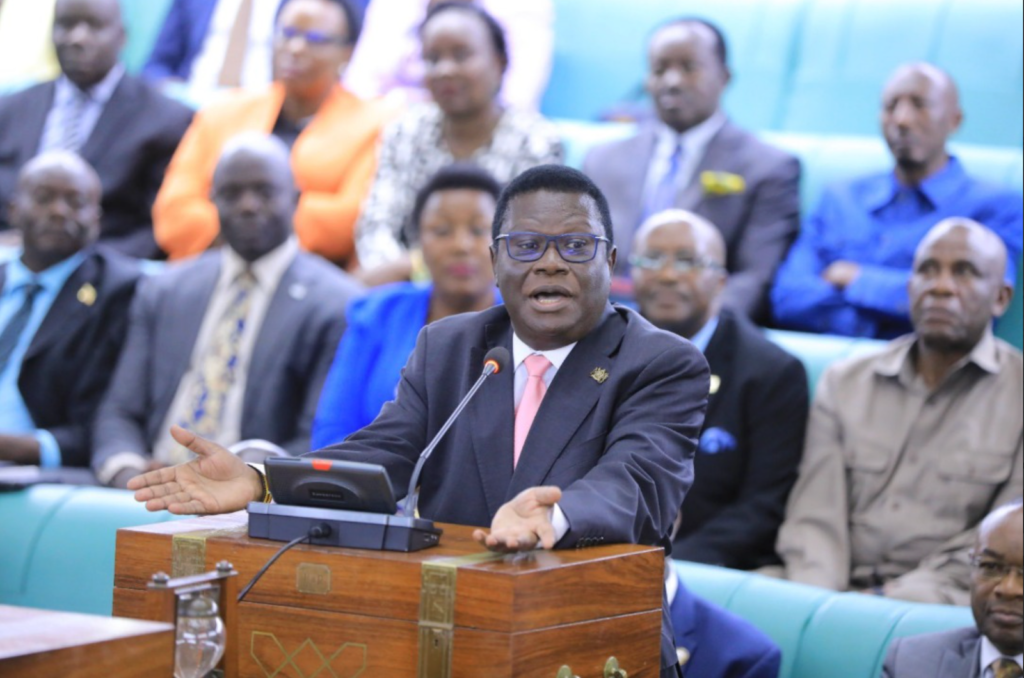
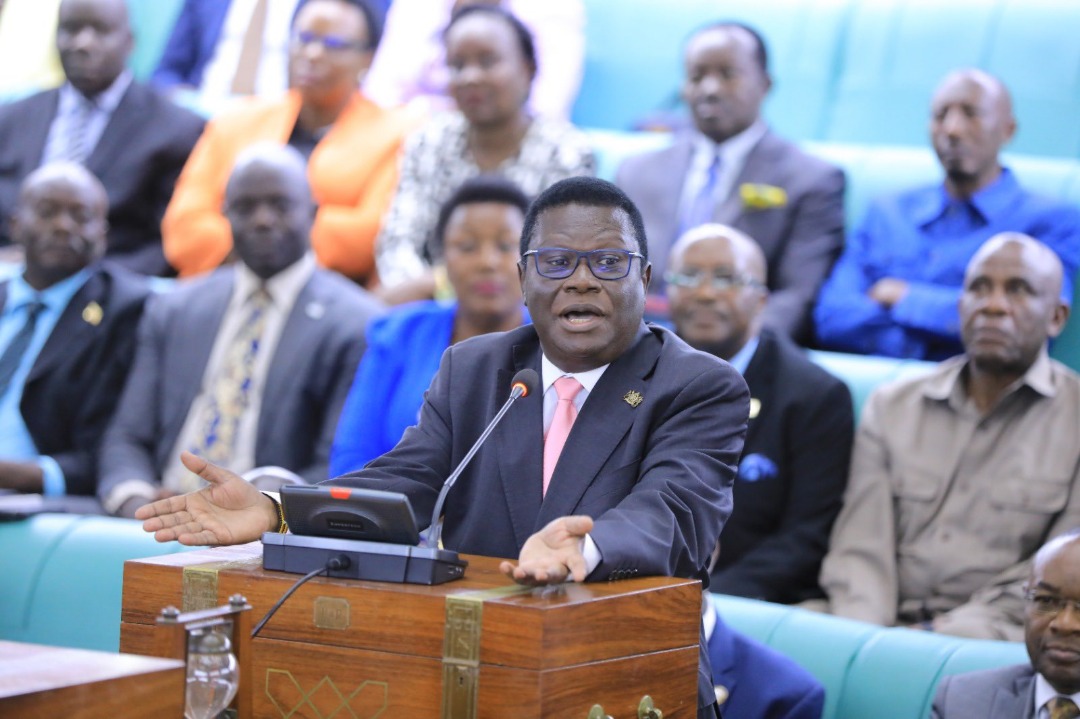
Justice Minister Nobert Mao leads the reading of the Copyright Amendment Bill 2025 on the floor of Parliament. Photo credit: Patrick Ssentongo
Government Resistance and a Divided Policy Position
During scrutiny of the Bill by Parliament’s Legal and Parliamentary Affairs Committee, both the Attorney General, Hon. Kiryowa Kiwanuka, and Ms. Mercy Kainobwisho, the Registrar General of the Uganda Registration Services Bureau (URSB)—the government agency responsible for business and legal registrations—openly opposed the introduction of the Private Copy Levy.
Their opposition, however, was met with strong pushback from the creative sector.
According to Charles Batambuze, Executive Director of the Uganda Reproduction Rights Organisation (URRO) —the Collective Management Organisation for literary works—Government’s resistance to the PCL reflects a misunderstanding of how creative works are consumed and exploited in the digital age.
“Private copying is no longer an exception—it is the norm. Digital devices are now the primary means through which creative content is reproduced, shared and consumed. Ignoring this reality leaves creators exposed and uncompensated,” Batambuze argues.
Notably, the Minister of Gender, Labour and Social Development, Hon Betty Amongi emerged as the only Government official to support the proposal, clarifying to the Committee that there was no formal Cabinet position opposing the PCL. PCL proposals were however included in draft submissions to cabinet; they were ultimately rejected. However, no official Cabinet report outlining the reasons for rejection was made public. What filtered through instead were second-hand accounts, reported speech and fragmented objections.
The Minister further acknowledged that the digital revolution had permanently altered how creative content is produced and consumed—an impact that copyright law must respond to, rather than deny.

URSB Registrar General Ms. Mercy K. Kainobwisho, appearing before the Parliamentary Committee on Legal and Parliamentary Affairs to present their position. Photo credit: Patrick Ssentongo
Addressing the Concerns
During consultations on the proposed Private Copy Levy (PCL), a range of concerns, questions and claims were raised by policymakers and technocrats. These included whether the levy exists elsewhere in Africa, fears that it would add to Uganda’s tax burden, increase the cost of digital devices, slow digital transformation, unfairly target certain users or devices, and undermine education, agriculture and industry. There were also questions around monitoring, collection, distribution of funds, and whether the Government should collect money on behalf of private creators at all.
These concerns, while legitimate on the surface, were met with detailed counter-arguments from artists and rights organisations.
According to creative entrepreneur Geoffrey Ekongot, also the Executive Director of Uganda Musicians Association, an organization representing over 4,000 musicians, many of these concerns stem from a misunderstanding of how private copying works in practice and how levies are designed to function. He helps us break each down.
On claims that the levy would be unfair because not every device owner copies content, Ekongot argues that the PCL operates on the same logic as other collective contributions. Citizens routinely pay taxes for public goods they may never directly use, yet society as a whole benefits. In the same way, even users who do not consciously consume music or books still benefit from a digital ecosystem powered by creative content—whether through education, information, entertainment or innovation. Private copying, including indirect and unintentional use, is now embedded in everyday digital activity and cannot realistically be policed on an individual basis.
Concerns that the PCL would slow technology adoption are, in his view, overstated. At a proposed rate of about three percent, the levy represents a marginal cost in relation to the price of most devices. “On a UGX 500,000 smartphone, the levy amounts to roughly UGX 15,000—less than the cost of many common accessories.”
More importantly, content—not hardware—is what drives demand for devices. Smartphones, computers and tablets are purchased primarily to access music, films, books, educational materials and online platforms. Compensating creators strengthens the content ecosystem, which in turn sustains and even accelerates digital uptake rather than hindering it.
Arguments that devices used in education, agriculture and industry should be exempt are also contested. Ekongot notes that these sectors rely heavily on freely copied copyrighted content. In universities, large-scale photocopying of textbooks is widespread; in agriculture, farmers and extension workers routinely share manuals, videos and research materials. While these practices support development, they systematically deprive authors, researchers and publishers of income. The PCL offers a balanced solution—preserving access while ensuring creators receive compensation through collective mechanisms.
On fears that the levy would amount to a new tax burden, he emphasises that the PCL is not a general tax but a rights-based compensation mechanism. Major taxpayers such as telecom companies, beverage manufacturers and entertainment-driven businesses derive substantial economic value from creative content that fuels data consumption, nightlife and advertising. The levy simply ensures that creators share in the value their work generates across the economy.
Questions around monitoring and distribution, he argues, are not unique to Uganda and have been resolved elsewhere through collective management organizations, clear governance frameworks and transparent distribution systems. The concern that the Government cannot collect money for the private sector is addressed by structuring the levy as a statutory compensation mechanism, not general revenue, with funds ring-fenced for rights holders rather than absorbed into the Consolidated Fund.
Ultimately, Ekongot maintains that the PCL is not about taxing technology or punishing users, but about acknowledging an undeniable reality: private copying is widespread, creators are losing income, and without a compensatory mechanism, the sustainability of Uganda’s creative, educational and knowledge ecosystems remain at risk.
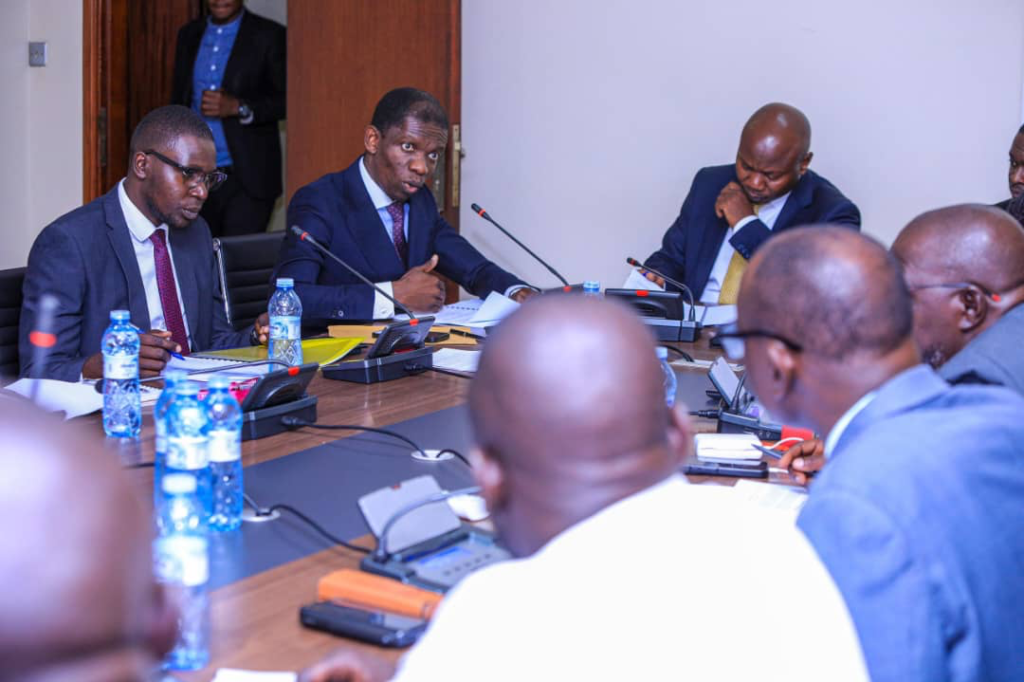
URSB officials during the parliamentary committee session where concerns over the Private Copy Levy were raised.
Photo credit: Patrick Ssentongo
Why the PCL Matters for Culture
Under the National Culture Forum (NCF), Uganda’s apex body for creative sector associations, artists have formally petitioned Parliament to reinstate the PCL in the Copyright and Neighbouring Rights Amendment Bill, arguing that it is essential to the sustainability of the country’s creative economy and aligned with regional and international best practice.
If well designed and transparently managed, advocates argue, the levy could provide a stable and predictable income stream for creators across music, film and publishing.
“If Uganda wants a vibrant, fair and sustainable creative industry—one that rewards innovation and talent—then the private copy levy should be treated as an urgent reform, not a theoretical proposal,” said Daniel Kazibwe, alias Ragga Dee, renowned musician who chairs the NCF.
As Uganda awaits the second reading of the Bill, expected after the January 2026 General Elections, the PCL debate remains unresolved. Experiences from countries that have adopted similar schemes demonstrate that modest, pooled levies, collected consistently, can support entire creative ecosystems while encouraging local content production.
For consumers, the policy challenge lies in balancing the affordability of digital devices with the protection of creative rights. While a levy may marginally increase gadget prices, the broader question is whether a digital economy can remain inclusive and fair if creators are excluded from the value generated by their work—particularly in a context where young people are both major consumers and emerging producers of digital content.
For the wider cultural economy, a functional levy would signal to investors, platforms and development partners that Uganda is serious about copyright protection and creative sector governance—key factors in attracting investment and partnerships.
Within the framework of Connect for Culture Africa (CfCA), which advocates for stronger legislative frameworks and increased public investment in culture, the PCL debate reflects a continental priority. The African Union has called on Member States to allocate at least 1% of national budgets to Culture, Arts and Heritage by 2030. Legal reforms such as the PCL are part of how this commitment can be realised.
As Parliament revisits the Bill, the call from artists is to recognise PCL as a structural reality of the digital age and adopt reforms that protect creators, strengthen cultural industries, and position culture as a driver of sustainable development.
Editor’s Note

Patrick K. Ssentongo is a Ugandan journalist, storyteller, and content producer whose work spotlights the intersections of policy, culture, and community voices. In this piece, he looks at what it takes to pass a meaningful reform in support of artists’ rights. In this article, Patrick takes us inside Uganda’s ongoing Private Copy Levy (PCL) debate—unpacking the shifting alliances, political hesitations, and legal questions that have shaped the Copyright Amendment Bill of 2025.
As the law inches closer to being passed, this piece captures a pivotal moment for Uganda’s creative economy, spotlighting how collective organizing, parliamentary engagement, and persistent advocacy have helped bring cultural policy into the national spotlight.
At Connect for Culture Africa (CfCA), we see this as part of a broader continental effort to secure sustainable frameworks for public investment in the arts—advocating for at least 1% of national budgets to be dedicated to culture.